
Card and Board - Key to the Kingdom
By: Justin Baker
Editor’s note: Card and Board is a new experimental segment in which we review (you guessed it) card and board games. It may delve into other realms of tabletop gaming from time to time.
My parents divorced when I was about eight years old, so I don’t have a whole lot of “happy together time” family memories. It’s not like I had an awful childhood or anything, far from it. But it was rare that my home life lined up with the depictions of happy families I’d see eating dinner together in commercials. One such rare instance was the night my family and I played Key to the Kingdom. In fact, it’s the only board game I remember playing with all four of us: myself, my brother, and our parents. I can’t say I remember it well, really it’s just a fuzzy memory of intense excitement and adventure as I built a little plastic bridge and flipped the board in and out (more on those aspects later). But, I remember that it was very exciting and that I was very happy. I don’t remember ever playing the game again, but I spent many evenings taking the game out and just admiring the art and playing with the pieces.
Fast forward to today, and my sudden board game obsession. Anyone who listens to the show regularly knows I go through cycles of obsession: CRTs, Game Boy games, Magic cards, etc… Whatever tickles my fancy that particular month. This month, it’s all about board games, and one of the first ones that I looked up was Key to the Kingdom. A few dollars spent on eBay, and several days laters I was once again the proud owner of a copy. This was, of course, despite the reviews and forum posts on Board Game Geek that said the game has aged poorly and is hardly worth revisiting today. I’m glad I ignored that advice.
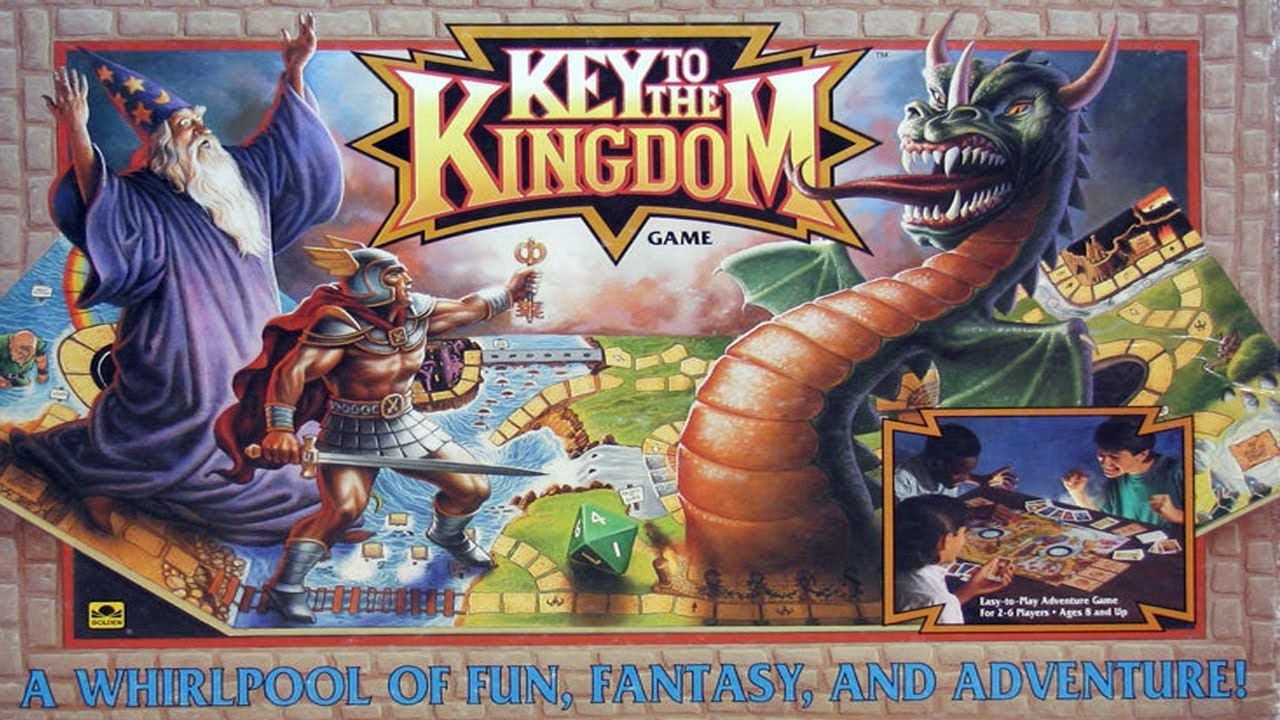
Granted, the game uses very simplistic, dated mechanics. Roll to move, in 2017? Don’t make me laugh sarcastically while sipping my latte in my favorite board game cafe. No, it’s not as svelte as the latest Kickstarter darling, but it still oozes with charm. For the uninformed, the “innovation” of the game is that the board folds out into a double sized board with even more monsters and obstacles within. The first player to reach the exit with the key and at least one treasure wins. But, both the randomly assorted prizes and the transforming board inhibit that goal. When the board is folded out it’s impossible to reach the exit, and when the actual physical moving of the board occurs any players in the area to be flipped have only three rolls to escape or be sucked into the vortex themselves.
So, the game consists of winning and stealing treasures back and forth from each other until someone ends up with the required pieces to win. At which point the game devolves into a footrace to steal the key for yourself or at least fold the board onto your opponent to halt their progress. The criticism I hear levied against the game the most is that the constant checking of the Hazard Handbook (used to determine how to overcome obstacles) is cumbersome, but as someone who has to constantly check rulebooks anyway when playing modern board games I don’t find it to be very different than my average board game experience. The second most prominent criticism is that the game is largely luck based, and that’s very true. From the obstacles to the monsters, it’s all about having the right combination of equipment cards and getting lucky dice rolls. But I think that level of variance fosters a fun, light-hearted environment. Sure, there’s something to be said for the satisfaction one gets from meticulously out-strategizing your opponent, but luck removes the adversarial nature from the game. You’re still trying to inhibit each other, but no one feels picked on or like they’re not good enough because everyone is equally at the mercy of the dice.
In the last game I played I was standing on the far side of the board with both my opponents between me and the exit. I was able to roll into the key holder (thus stealing the key), roll past an obstacle, and then miraculously roll a 7 out of 8 to exit the kingdom and win. All while the board itself was crashing down on my head. Failure meant being sucked into the vortex, success meant destroying my opponents. And it didn’t take me four and a half hours of meticulous strategic planning, just a wild hair and some lucky rolls. These are the kinds of moments that I cherish when I play tabletop games: moments not about about making all the right decisions, but about rolling dice and seeing what happens next.
If you’re feeling a bit nostalgic for some totally radical late 80s/early 90s fantasy art and don’t mind some simplicity in your board games then I can’t recommend Key to the Kingdom enough. The best way I can describe it is that Key to the Kingdom happens to you. You roll dice and the board just does what it’s going to do with or without your consent or decision-making, like a vindictive dungeon master. Close your eyes and guess your roll, roll over a thirteen with two rolls, built a tiny plastic bridge with your rolls. Forget about all those hand-painted miniatures and massive grid-based maps and have some fun!