
Wonder Boy: The Dragon’s Trap - Retro Done Right
By: Chris Saturn
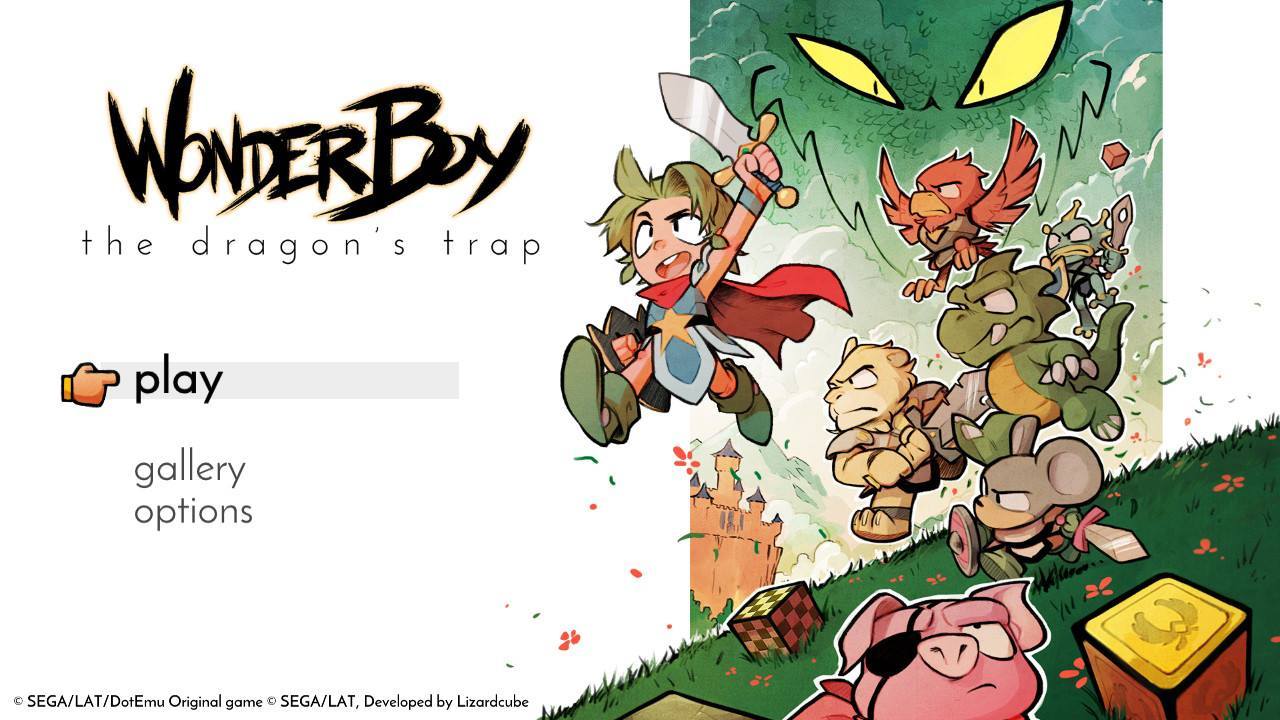
Developer: Lizardcube (original game developed by Westone)
Publisher: DotEmu (under license from Sega)
Platform: Playstation 4, Switch, Xbox One (PC port coming later this year)
In 1993, Nintendo blew my little mind wide open. With Super Mario All-Stars, they showed me that they could take an existing 8-bit game, upgrade the graphics and sound, and make it feel like an all new experience. It was incredible. Instantly, I knew what the future of gaming would be like; all of my favorite classic titles were destined to be upgraded for future hardware, and there’d be no incentive to keep an old console. Surely, we were only months away from an upgrade of Mega Man 1-6 on one cart, featuring the graphics of Mega Man 7.
Obviously, that didn’t happen. In fact, Super Mario All-Stars is somewhat of an anomaly. Rarely do games get that upgrade treatment. And, typically, when they do, it’s an entirely new game that just happens to share the general flow of the original (see: Metroid Zero Mission). Perhaps that’s what so special about Lizardcube’s incredible recreation of Wonder Boy: The Dragon’s Trap.
First, let’s back up a bit. Let’s take a look at the base game.
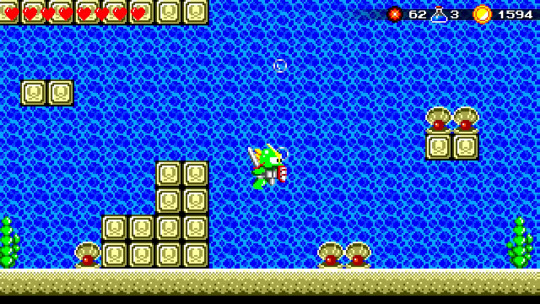
Without confusing you all with the timeline of Wonder Boy titles, The Dragon’s Trap is the third Wonder Boy game released on the 8-bit Sega Master system, and the second game in what is now known as the Monster World series. Taking not just the character growth and exploration-based gameplay from Wonder Boy in Monster Land (in a style that we might now refer to as Metroidvania), The Dragon’s Trap actually starts out during the final chapter of the previous game. A short introductory tutorial-like area plays out the conclusion of the previous game. Just like in the older title, Wonder Boy assaults the lair of Meka Dragon for a grand confrontation. However, unlike in Monster Land, now Wonder Boy is afflicted with a curse that turns him into a dragon Lizard-Man!
After leaving the intro area, Wonder Boy Lizard-Man must explore the world to find the other dragons in an attempt to alleviate his curse. Instead, he just becomes further cursed turning into a tiny person Mouse-Man, a merman Piranha-Man, a furry Lion-Man, a hawk man Hawk-Man (wait…), and finally back to himself (referred to in-game as Hu-Man). Along the way, you’ll gather coins to buy new gear, utilize the unique abilities and strengths of your various transformations, and ultimately defeat the Vampire Dragon.
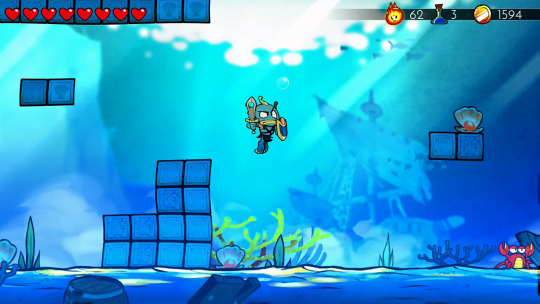
Now, onto the remake. Lizardcube has done a phenomenal job of capturing the feel of the original game. In addition to the original 8-bit graphics and sound, you’re also given the option of absolutely breathtaking hand-drawn visuals and gorgeously composed orchestral sound. It’s really an amazing transformation. If, at any point in the game, you happen to forget how amazing it is, you need only press a button to be transported back in time almost 30 years. Pressing the right trigger (or ZR button or R2 or whatever) will revert the graphics to their original SMS style, while clicking the right analog stick will revert the music. Both of these actions can be undone just as easily, and with no interruption to the gameplay. In 8-bit mode, you’ll still know that you’re playing a remake due to the 16:9 aspect ratio and modern GUI (in fact, the menu screens retain their modern appearance even in retro mode :( ).
In addition to the truly remarkable cosmetic upgrades, there are a handful of relatively minor upgrades to the actual gameplay. When encountering a new feature or mechanic for the first time, an unobtrusive text-over will explain how to use the new mechanic (for example, a quick text blurb describes how to cling to certain walls as Mouse-Man). This both assists new players while also pointing out the elegant game design of the original, which allowed players to quickly (and often accidentally) learn their new abilities. Some backgrounds have also been altered to make navigation and discovery easier than before.
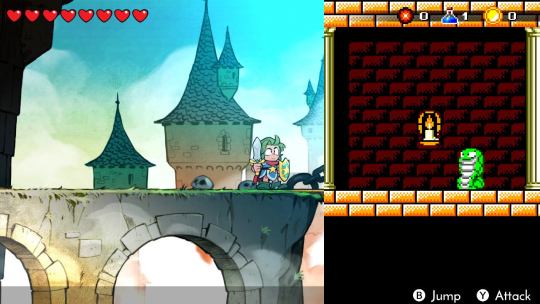
Other changes in the remake include some very minor enemy placement changes, multiple difficulty settings, some equipment tweaks (the Thunder Blade is now the Thunder Ring and no longer needs to be equipped), and the removal of the charm stones (mostly…). In the original, you’d need to find the very rare charm stones in order to convince shopkeepers to let you see all of their wares. In the new version, they’re more than happy to sell (almost) anything to anyone that’s got enough gold (this might be my favorite change).
The changes from the original are so minor that you can even still generate passwords that work on the original Master System and Game Gear releases. These new/retro passwords don’t seem to be perfect, but it’s amazing that this is even an option. Also, due to the change in how the shops work, this means you can get some equipment earlier than intended, so long as you’re willing to grind for gold. Using the password system, this equipment absolutely transfers over into the classic versions. Fortunately, you won’t need to rely on the passwords; the new release supports autosave, and you can resume your progress whenever you’re ready.
Oh, and we shouldn’t forget the addition of Wonder Girl. You can now choose to play as either Wonder Boy or Wonder Girl. The change is purely cosmetic, but why not? It doesn’t hurt the game at all, and it could really add something for someone out there.
Another addition to the game is a new post-game bonus area. I haven’t gotten too far into this yet, but I can say that it’s brutally difficult compared to the main game.
Aside from the relatively minor gameplay tweaks and relatively major visual and audio upgrades, there’s also an absolutely incredible gallery mode. Here, you’ll get to see some early sketches, crude animations, and even video of the recording sessions for the amazing new soundtrack. I typically skim past in-game bonus galleries, but this one is really just fantastic. Seeing the discarded early designs for some of the forms (and the notes scribbled on them) really adds to the charm.
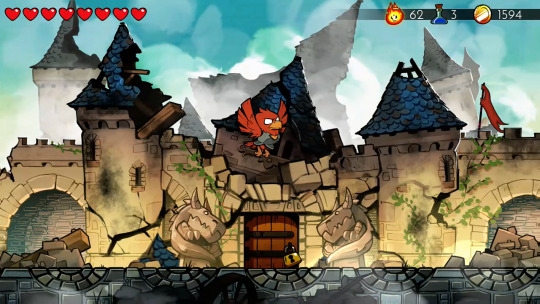
Of course, nothing is perfect. The initial release version of the game seems to have some minor glitches, that will presumably be patched out in a later release. Thus far, on the Xbox One version, I’ve had the music on the title screen drop out several times. Also, I’ve noticed some occasional stutter. It’s almost like an early CD-ROM game attempting to load additional resources. If you’re facing down against a boss or deadly samurai, this can be pretty frustrating. Again, I imagine it can be patched out later on. I haven’t yet encountered these issues in my time with the Switch release, but I haven’t put as many hours into that version, either.
Overall, this is an absolutely astounding remake of a mostly forgotten classic. Like Mario All-Stars, the actual game physics and mechanics remain completely unchanged, while the presentation received a drastic and much-needed overhaul. I’m very curious as to how this will be received by the non-retro community. Can a modern player overcome some clunky mechanics and find the gem hidden underneath? Can the gorgeous presentation distract a spoiled modern gamer from some occasionally unforgiving gameplay? As I write this, most of the reviews online haven’t been published yet. We’re yet to see how the general public will receive it.
Most importantly of all, I hope other companies take note. I’m still waiting for the Super Mario All-Stars style upgrade to many of my childhood favorites. But at least, while I wait, I’ve got an incredible upgrade of The Dragon’s Trap to keep me company.